
Live Baccarat Online Casinos in the UK: What to Check
 Available in GB
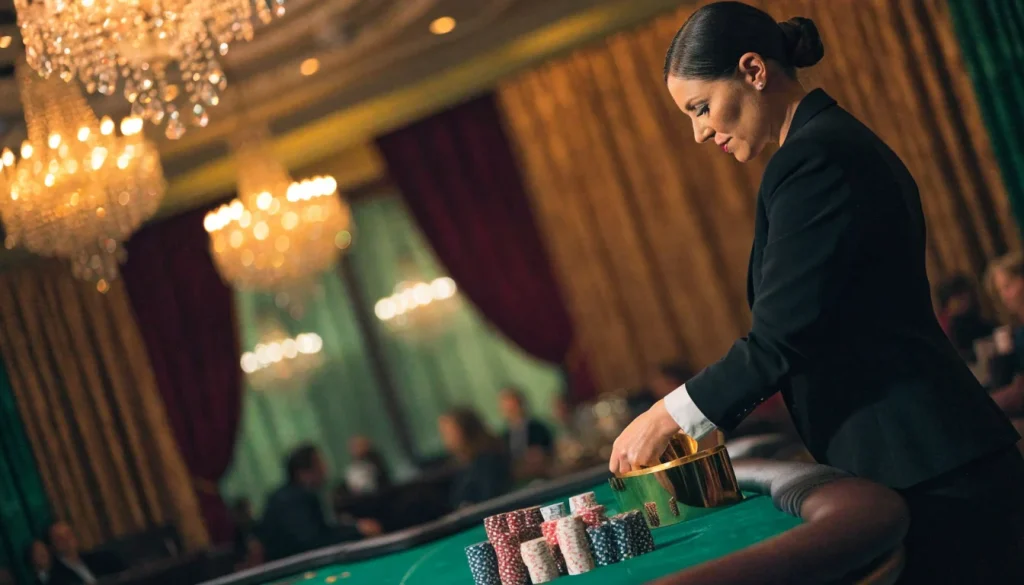
See how live baccarat differs from digital games, and what to consider about table limits, rules and bonus terms.
Table of Contents
- Finding Baccarat in a Live-Casino Lobby
- What Makes a Baccarat Casino a Suitable Fit
- The Baccarat Table: Player, Banker and Tie
- Playing Baccarat in a UK Live Casino
- Real-Money Play, Table Limits and Budget
- Baccarat Among the Live Casino Tables
- Baccarat’s Rules, Commission and House Edge
- When Baccarat Is One Game Among Many
- The Dealer, the Table and the Connection
- Baccarat Bonuses and the Terms Behind Them
- Games
Finding Baccarat in a Live-Casino Lobby
A casino’s general game catalogue does not establish that it offers live baccarat. The useful distinction is between a digital baccarat game, where the action is generated by software, and a live dealer table, where play is streamed from a studio and a human dealer handles the game. Both may sit under the same broad casino heading, so the lobby’s labels matter.
The first place to look is the live-casino area, rather than a general games list. Some lobbies separate live tables from digital games; others place them in a shared catalogue with filters or categories. A search for “baccarat” can help locate entries, but the title or thumbnail alone may not reveal whether the game is live. A label such as “live dealer” or a listing inside the live section is a clearer sign. If the distinction remains unclear, the game description is the place to check before opening a table.
This small act of sorting says something about the modern casino: the same game can be presented as software or as a broadcast, and the lobby makes those formats look like neighbours. They are not quite the same thing. In live baccarat, a studio feed shows real-time gameplay with a human dealer; players make their bets through controls on the screen. The dealer and the interface occupy separate parts of the experience, though the lobby may compress both into a single tile.
Choosing a live baccarat casino involves more than the game itself, so it is worth checking practical details before you play. This reference highlights the payout information available for each listed operator.
1. NightLuck
Payout speed: 1-3 business days NightLuck lists a payout speed of 1–3 business days.
2. Dieselwin
Payout speed: 1-3 business days Dieselwin lists a payout speed of 1–3 business days.
3. Jetsetspins
Payout speed: 1-3 business days Jetsetspins lists a payout speed of 1–3 business days.
4. Chanze
Payout speed: 1-3 business days Chanze lists a payout speed of 1–3 business days.
5. SpinFormula
Payout speed: 1-3 business days SpinFormula lists a payout speed of 1–3 business days.
6. WinBeast
Payout speed: 1-3 business days WinBeast lists a payout speed of 1–3 business days.
7. BeOnBet
Payout speed: 1-3 business days BeOnBet lists a payout speed of 1–3 business days.
8. EvoSpin
Payout speed: 1-3 business days EvoSpin lists a payout speed of 1–3 business days.
9. Revery Play
Payout speed: 1-3 business days Revery Play lists a payout speed of 1–3 business days.
10. NightWin
Payout speed: 1-3 business days NightWin lists a payout speed of 1–3 business days.
A listing should therefore be read for what it actually identifies. A live table is not simply a digital game with a camera-like decoration, nor does the word “baccarat” on its own establish a live format. The relevant clues are the live-casino category, an explicit live-dealer label and a description indicating streamed gameplay. If the lobby offers filters, selecting the live category can narrow the display without assuming that every baccarat entry belongs there.
The same checks apply when browsing baccarat casino sites in the UK. A site may advertise a wide casino selection, but that broad description does not confirm that live baccarat is among its tables. Availability is a specific feature, not a synonym for having casino games in general. No ranking can replace that simple distinction: a “best” choice depends first on whether the requested format is actually present, and no list of supposed leaders can establish it for every lobby or at every point in time.
There is also a legal boundary behind the lobby. Online gambling in the UK is lawful only through licensed and regulated sites; a remote operator serving the British market must hold the relevant UK Gambling Commission licence. The licence is not a decorative badge for the live section but part of the conditions under which an operator can offer gambling to customers in the market. A listing for a live table should be considered in that wider site context, rather than treated as proof of legitimacy by itself.
Keno Payouts vs Fast Casino Withdrawals in the UK
A careful scan need not become an investigation. The aim is to establish three things: that the site is presenting a live-casino section, that baccarat appears within it, and that the entry is described as a human-dealt streamed game rather than a software-only version. If one of those points is absent, the lobby has not yet answered the basic question. A polished tile is still only a tile.
The live format begins with a camera view from a studio and an on-screen betting interface. That is enough to identify the kind of product being offered, without inferring anything about its speed, minimum stakes or suitability; those are separate questions. The visible dealer is part of a real-time stream, while the player’s choices are made digitally. A hybrid, not a paradox.
This overview is for entertainment purposes only, not gambling advice.
What Makes a Baccarat Casino a Suitable Fit
A suitable baccarat venue is not simply the one with the grandest lobby or the longest row of tables. Fit is more personal, and less flattering to advertising. It depends on whether the live format matches the kind of attention a player wants to give the game, and whether the practical conditions allow that attention to last.
Live baccarat is a streamed experience with a human dealer, making it inherently slower than digital versions. This pace allows for casino rituals but requires more patience from the player.
Live baccarat asks for patience. A human dealer manages the hand in real time, so the pauses and gestures that give the game its casino character also slow it down. Digital versions move faster. Neither pace is inherently superior: one makes room for the rituals of a table, the other reduces the ceremony. A player drawn to a measured, watchable contest may find the live version more satisfying; someone who prefers quick decisions may find its intervals excessive. The best baccarat casino, in this sense, is not an abstract winner but a setting whose pace does not feel like an inconvenience.
That distinction matters because online play can make a casino table seem deceptively close at hand. A live game is still a stream, not a private room. Its movement depends on a stable internet connection, and a connection that falters can turn the table’s deliberate rhythm into a series of interruptions. The question is not whether a venue looks polished in a still image, but whether the live experience is workable in the conditions in which it will actually be used. A connection that is reliable for ordinary browsing may not feel reliable enough when the action is unfolding in real time.
The same practical scrutiny applies to the table’s minimum bet. Live games have higher minimums than digital versions, so the choice of format can affect what a session requires before it begins. This is part of suitability, not a minor detail to discover after settling in. The table may appeal in every other respect and still be a poor match if its entry point does not fit the player’s intended scale. There is no virtue in mistaking a larger minimum for a more serious game.
Classic Slots Online in the UK: Free Play and Real Money
Atmosphere also deserves a cooler assessment than promotional language tends to allow. The dealer and the visible table create a sense of presence that a digital game cannot reproduce in quite the same way. That can make the experience feel more social and grounded in the old public theatre of gambling: a person deals, others watch, and the action has a shared pace. Yet the screen does not become a room merely because a dealer appears within it. For some players, that mediated presence is precisely the appeal; for others, it is an elaborate way of waiting.
A comparison between baccarat casinos therefore works best when it begins with the player’s preferred conditions rather than a claim of universal quality. Pace, connection and minimum bet are plain tests. The desired degree of atmosphere is harder to measure, but no less real. A table can be technically accessible and still feel wrong for the occasion.
The most suitable choice is the one that asks for neither more patience nor more connectivity nor more money than the intended experience can comfortably accommodate. That is a modest standard. It is also more useful than a crown handed out to a supposed best online baccarat casino, as though every player arrived with the same appetite for ceremony.
Do
- Prioritise a stable internet connection for real-time play
- Check the table’s minimum bet before starting
- Match the game’s pace to your personal preference
Don’t
- Assume a polished lobby image guarantees a workable experience
- Mistake a higher minimum bet for a more serious game
- Expect the same speed as a digital baccarat version
The Baccarat Table: Player, Banker and Tie
Baccarat gives its wagers names that can sound like social roles. The Player and Banker are not two people competing for the bettor’s allegiance; they are the labels attached to the two hands dealt in the game. The choice is about which hand will finish nearer to nine. A third option, Tie, covers the possibility that both hands finish on the same total.
That distinction matters because the names invite a small misunderstanding. A Player bet does not mean that the person placing it is taking control of the cards, and a Banker bet does not put the bettor in the dealer’s position. The cards follow the game’s fixed procedure. The wager simply selects an outcome.
The two hands begin with two cards each. Their values are added to produce a total, but baccarat keeps that total within a single digit: if the sum goes above nine, only its final digit counts. A hand adding to twelve, for instance, is scored as two. The arithmetic is deliberately spare. Baccarat is less a contest of calculation than one of waiting to see which of two small totals comes closest to the target.
Nine is the highest possible score under this method, not a threshold that can be exceeded into a better result. A total of eight remains eight; a total of nine is nine. If the hands do not match, the one closer to nine wins. If they do match, the Tie outcome applies. This is the basic structure behind the familiar three-way choice on a baccarat table.
Progressive Slots Online in the UK: How Jackpots Work
The comparison is made only after the dealing procedure is complete. In some rounds, the original pair of cards is enough; in others, a hand receives a third card. Whether that happens depends on the totals already showing and the game’s specific drawing rules. It is not a discretionary move by the person who placed the wager. The third card belongs to a prescribed sequence, rather than to a player choosing to take another card as in games where decisions are made hand by hand.
That fixed sequence can make baccarat look simpler than it is. The visible action is brief: two hands, their totals, and perhaps an additional card. Yet the third-card rule depends on the state of the hands, and a card dealt to one side can affect whether the other side draws. The procedure is therefore easier to follow once its purpose is clear: it determines how the two totals are completed before the closeness to nine is judged. The cards do not negotiate.
For someone new to the table, it helps to keep three questions separate. Which hand is labelled Player? Which is labelled Banker? Do the completed totals match? The first two identify the outcomes being backed; the last distinguishes a Tie from a win for one side. The scoring rule then resolves how close each hand came to nine. Mixing these steps can make the labels seem more complicated than the game itself.
Baccarat Scoring Process
Step 1: Deal cards
Two cards are dealt to both the Player and Banker hands.
Step 2: Calculate totals
Values are added, and if the sum exceeds nine, only the final digit is counted (e.g., 12 becomes 2).
Step 3: Apply third-card rules
Depending on the current totals, a third card may be dealt according to fixed procedures.
Step 4: Determine winner
The hand closest to a total of nine wins, or a Tie is declared if totals match.
There is no need to treat “Player” as the person making the bet, or “Banker” as a separate opponent making choices. Both are names for hands within the same round. Once the cards have been dealt according to the rules, the bettor’s selection either corresponds to the hand closest to nine or to a matching total. This is standard baccarat’s central contest: two hands, a shared target, and a narrow set of possible outcomes.
The simplicity is formal, not mysterious. A wager is placed on Player, Banker or Tie; two cards are dealt to each hand; totals are reduced to their final digit when necessary; and the third-card rules determine whether either hand receives another card. Then the totals are compared. The table’s vocabulary may suggest a duel between people, but the contest is between two scored hands.
Playing Baccarat in a UK Live Casino
A live baccarat table is not simply a digital game with a dealer-shaped image added to it. The play is streamed from a studio in real time, with a human dealer handling the cards while players use an on-screen interface to take part. The screen becomes a window onto a small, managed performance: cards, hands, pauses and decisions unfolding in the same sequence for everyone at the table.
That shared timing is part of the appeal. A digital version can move directly from one round to the next; a live table has to wait for the dealer and the players’ actions. The rhythm is therefore slower, and the delay is not a technical flaw to be corrected. It is built into the format. Baccarat’s rules may be fixed, but live play gives those rules a human pace.
Fastest Payout Online Casinos in the UK: Evidence
There is something sociable in that arrangement, even when the players are physically alone. The dealer’s presence supplies a point of attention, and the real-time stream makes each round feel like an event rather than a sequence of abstract prompts. The atmosphere is not the same as sitting in a casino, of course: a camera frames the room, and the interface mediates every move. Still, the table has a visible human centre. The distinction matters.
The trade-off is plain. Digital play is quicker; live play takes longer. A player who wants rounds to pass rapidly may find the pauses irritating, while someone drawn to the ceremony of a dealt game may regard them as the point. Neither preference is more serious than the other. Speed is a design choice, not a measure of skill.
In practice, the screen asks for a different kind of attention. The table must remain visible, and the interface has to be used in time with the live round. A stable internet connection matters because the experience depends on a continuous stream; a disrupted picture can make a real-time game difficult to follow. There is less room for the frictionless, instant rhythm of a purely digital format. The dealer is not waiting in a separate world.
The live format also changes the feeling of participation. It offers real-time interaction and something closer to the atmosphere of a physical casino, without making the home screen a casino floor. That resemblance is necessarily partial. The room is observed through a camera, and the player’s actions arrive as selections on a display. Modernity has not abolished distance; it has made distance playable.
Live Baccarat Experience
- Real-time streaming provides a human centre and shared timing
- The rhythm is slower than digital play due to human dealer actions
- A stable internet connection is critical to avoid disrupted gameplay
- It offers a more theatrical, albeit less rapid, form of contest
For some, that is enough: a human dealer, visible cards and a common pace create a more tangible contest than software alone. For others, the slower round is a price paid for atmosphere. Live baccarat online in the UK sits between those expectations, not as a faster way to play but as a more theatrical one. The cards still decide the result. The camera gives them an audience.
Any free-play version is for entertainment and practice only; it does not pay real winnings. Real-money gambling is also entertainment, not financial advice. The distinction is less glamorous than the studio lighting, but more useful.
Real-Money Play, Table Limits and Budget
A live baccarat table turns a balance into a sequence of decisions: how much to stake, how often to return to the table and when to stop. The amount shown as a minimum is not a sensible budget by itself. It is simply the smallest permitted wager at that table, and the pace of live play can make repeated small stakes add up.
A specialist review has reported live baccarat and roulette tables starting at around 20p, while blackjack tables often begin at higher limits. That is a report from one review, not a dependable rule for the market. Limits vary between tables and can change, so the figure should not be treated as a promise of what a particular casino will offer. The table’s own limit is the relevant one before a real-money session begins.
Keno Online Casinos in the UK: Draws and Odds
Budgeting is less dramatic than a lucky streak and more useful. A fixed amount set aside for gambling should be affordable to lose; it should not come from money needed for rent, bills, food or other commitments. Once that amount has been reached, the session is over. Increasing a stake to recover losses, or extending play because winnings seem close, turns a planned cost into an open-ended one.
This matters particularly in live play, where every round arrives through a human-paced sequence rather than a rapid digital interface. The intervals may feel measured, but they do not make a wager financially harmless. A clear stopping point, decided before the first bet, is more reliable than a judgement made while a balance is moving.
For real-money baccarat in the UK, the account must be with an operator holding the relevant UK Gambling Commission licence. Operators must verify a customer’s age before allowing deposits, and online gambling is legal for adults aged eighteen and over when the operator is licensed. The legal framework is not an endorsement of any particular table; it establishes who may lawfully provide the service.
Funding method matters too. Gambling accounts in the UK must not be funded with credit cards. The restriction also covers credit-card funds routed through a money service business, and operators cannot accept wallet payments where credit-card funds can be used for gambling. A payment method that appears to sit between a card and the casino does not change the underlying rule.
Financial Risk
Gambling accounts in the UK must not be funded with credit cards or credit-card funds routed through money service businesses.
The useful distinction is between available money and money already assigned to ordinary life. A deposit is not spare merely because an account accepts it. Live baccarat is entertainment, not a way to earn income or repair a shortfall. Its financial boundary should be set before play, and kept intact when the table’s pace makes another hand seem easy to afford.
A limit is a boundary, not a challenge. This content is for entertainment purposes only and is not gambling advice.
Baccarat Among the Live Casino Tables
A live-casino lobby places games beside one another, but the tables do not ask for the same kind of attention. Baccarat is organised around two hands; roulette around a wheel and a ball; blackjack around a player’s hand and a dealer across the table. The difference is more than decoration. It gives each game its own small social order.
Roulette makes chance visible in motion. At a live table, a dealer spins a physical wheel and the ball comes to rest on a number; a winning selection is one that matches where it lands. The wheel turns the outcome into a public event, watched by everyone at once. Computerised roulette keeps the same basic result in view, but generates it with a Random Number Generator rather than a dealer and a physical wheel. One is a spectacle of movement; the other is an electronic result.
French Roulette Online Casinos in the UK: Rules
Blackjack draws attention in another direction: towards the dealer. The game is streamed in real time, so the dealer is visible and players can interact with them. Its central contest is direct and legible: players try to beat the dealer with a hand totalling twenty-one points without going over. Even when several seats are occupied, the dealer remains the common point of reference. The cards make the contest, but the person dealing gives it a face.
Baccarat is less centred on either a moving object or a personal opponent. Its structure is a comparison between hands, with the Player and Banker labels marking the sides of the contest. The dealer handles the cards, yet the drama lies in how the two hands fare against one another, rather than in a player negotiating a decision against the dealer. That distinction makes baccarat feel more like a formal contest observed from the table than a conversation with the house.
The contrast can help make sense of the live-table tradition without turning every game into a variation of the same experience. Roulette offers a shared pause around the wheel. Blackjack keeps the dealer in the foreground and makes the player’s hand part of a direct challenge. Baccarat sets two hands against one another and lets the dealer conduct the comparison. Each has a different centre of gravity.
That difference matters more than a game’s position in a lobby. A person drawn to the visible suspense of a ball may find roulette’s physical wheel more compelling; someone who likes a dealer-facing contest may gravitate towards blackjack. Baccarat occupies a quieter middle ground: human dealing, but a contest defined by the hands rather than by a wheel or a direct duel. No table is simply another table.
Live Roulette
Centred on a physical wheel and ball, turning the outcome into a public spectacle of motion.
Live Blackjack
Focused on the dealer, where players aim to beat the house with a hand totalling twenty-one.
Live Baccarat
A formal contest based on the comparison between two hands, the Player and the Banker.
These distinctions also explain why a live format cannot be reduced to its digital counterpart. The physical wheel in live roulette and the human dealer in live blackjack are part of what the stream shows; a computerised roulette game instead relies on an RNG. Baccarat belongs to that live-table family through its human dealing, while its identity comes from the hand-based contest. The appeal is in the arrangement, not a promise of advantage.
This is context, not a system. Gambling is for entertainment, not advice.
Baccarat’s Rules, Commission and House Edge
Baccarat’s financial structure is less visible than its simple choice of wagers suggests. The Banker bet carries a deduction when it wins: a commission, typically set at five per cent of the winning amount. That charge is part of the price of the wager, not an optional table extra. The Player bet does not carry the same stated deduction, which can make the two choices look uneven even before the cards are dealt.
The commission reflects an underlying imbalance in the game’s outcomes and payouts. It does not make Banker a guaranteed or risk-free choice; it adjusts the return on a result that still depends on the deal. The house edge is the casino’s mathematical advantage across play, not a prediction that every individual hand will favour the house. A short run can go either way. Over time, the rules and payout structure remain in place.
Live Dream Catcher Casino UK: Game and Site Guide
The cards are not dealt according to a player’s preferred pattern. Each hand begins with two cards, and the fixed third-card rules determine whether another is drawn. Totals above nine are reduced to their final digit, so a hand’s score is not a conventional sum once it passes nine. These rules constrain the contest: choices concern which outcome to back, while the dealing procedure itself is prescribed.
That distinction matters when the commission is considered alongside the rules. A winning Banker wager is subject to its deduction, while the chance of a third card is governed by the game rather than by a staking plan. Increasing a stake after a loss, or changing it after a win, cannot alter either condition. A sequence may change the size of individual gains and losses; it does not rewrite the game’s probabilities or remove the commission.
Martingale systems are often presented as tidy arithmetic: raise the next stake after a loss, then recover the previous losses with a win. The neatness belongs to the formula, not to the table. A run of losses can grow the amount at risk, and no progression can compel a favourable result. In blackjack, staking systems such as Martingale can result in losses; the broader point is that changing bet size is not the same as changing the game’s edge.
A casino game of Baccarat is therefore shaped by two different kinds of rule. The dealing rules determine how hands develop; the payout terms determine what a successful wager returns. The commission is plain enough once noticed. The advantage is less theatrical, but no less real.
Attention Staking systems like Martingale cannot alter the game’s house edge or remove the commission on Banker wins; a run of losses can rapidly increase the amount at risk.
When Baccarat Is One Game Among Many
A live-casino page can place baccarat among several table formats without making it the centre of the room. Its presence says something about the shape of the offering: the casino is presenting games as distinct table experiences, rather than as a single uniform category. Baccarat may be a reason to visit, but it can also be one part of a wider live-casino setting.
That distinction matters when considering an online casino with baccarat. A game listed under a live heading belongs to a different format from a computerized table game, even when both appear within the same casino menu. The label is not decoration; it tells something about how play is produced. In live baccarat, the table is presented as a real-time dealer game. Computerized roulette, by contrast, generates outcomes using a Random Number Generator, or RNG.
Roulette makes the difference especially plain. In live roulette, a dealer spins a physical wheel and the ball lands on a number. In computerized roulette, the result comes from the RNG rather than a wheel being spun in a studio. Both may be called roulette, but they do not offer the same kind of event. One shows a physical process unfolding; the other uses software to determine the result.
A baccarat casino site may therefore contain more than one kind of table experience under one roof. The useful distinction is not simply between baccarat and roulette, but between live presentation and computer-generated play. A menu can bring the formats together; it does not make their underlying processes identical.
Live Casino Lightning Roulette in the UK: Rules and Play
There is a small social history in that arrangement. The casino gathers games with different origins and rituals, then makes them neighbours on a screen. Baccarat carries the form of a hand-based contest; roulette turns on a wheel and a ball. Their proximity is a modern convenience, but the games retain separate identities. The menu groups them. The mechanisms do not.
For anyone comparing casinos with baccarat in the UK, this is a more meaningful starting point than the sheer breadth of a catalogue. A live label indicates a real-time table format; a computerized roulette table indicates an RNG-driven one. In Britain, real-money online casinos must hold a current operating licence from the UK Gambling Commission. The regulatory frame applies to the operator, while the format describes how a particular game is run. Those are different questions, and a casino menu answers only one of them.
The Dealer, the Table and the Connection
A live baccarat table is not simply a digital board dressed to resemble a casino. Its pictures come from a studio, where a human dealer handles the game in real time; the player’s decisions travel back through an on-screen betting interface. That division is the defining practical feature: the table is physically present somewhere, while participation happens through a screen.
On a desktop, the streamed table can occupy the centre of the display, with betting controls arranged around it. On a phone, the same elements must share a smaller frame. The essentials remain: a view of the dealer and table, plus controls for placing a wager. The screen may change shape; the underlying arrangement does not. It is a remote seat at a real-time table, not a recording.
Live Table Readiness
- Verify the internet connection is stable for streaming
- Check the table’s minimum bet requirements
- Confirm the device display allows clear view of the dealer and controls
- Accept the measured pace of a human-dealt game
That distinction also makes the connection part of the experience rather than a background technicality. A stable internet connection is needed to keep the stream and the betting interface in step. If the picture stalls or the controls lag, the table becomes harder to follow at precisely the point when timing matters. Live play asks the household network to behave like a quiet corridor between studio and screen. It does not always oblige.
There is a trade-off in pace. A digital version can move through play more quickly, while a live dealer table takes time for the stream, the dealer’s handling and the on-screen process. The slower rhythm is part of its character, but it leaves less room for the brisk, continuous feel of software-led play. More ceremony, less speed.
The financial threshold can differ too. Live games have higher minimum bets than digital versions, so the table’s apparent accessibility on a phone or laptop does not necessarily mean that its entry point is equally modest. The screen makes the room remote; it does not make every seat inexpensive.
For anyone considering a live dealer baccarat casino, the useful distinction is therefore not between a large screen and a small one, but between a streamed human table and a faster digital simulation. The former depends on a steady connection, accepts a measured pace and may ask for a larger opening stake. A very modern arrangement, with very ordinary requirements.
Baccarat Bonuses and the Terms Behind Them
A baccarat promotion can look generous in its headline and still have little practical value at a live table. The difference lies in the conditions attached to it: whether baccarat is eligible, how much each wager counts towards the wagering requirement, and which other restrictions apply. A “baccarat casino bonus” is not a promise that every baccarat bet will help clear the offer at the same rate.
Jackpot Mobile Casinos in the UK: How Prizes Work
Live games may receive only a small share of the required wagering. One cited example is a 10% contribution: a wager at the table would count as only a fraction of its face value towards the requirement. Baccarat can also contribute at less than 100%, and a promotion may set different weights for different game types. The terms, rather than the banner, determine how the bonus works.
The pattern of UK welcome offers also deserves context. A specialist review’s snapshot found that most offers it examined were free spins for slot games, which could not be used at live tables. That is a finding from a particular review, not a guarantee about every casino or every promotion. It does explain why a welcome offer may be relevant to a slot player but of little use to someone interested in live baccarat.
A deposit bonus and a no-deposit offer are different kinds of promotion, but neither label answers the central question: can the bonus be used on baccarat, and does baccarat count towards its conditions? A no-deposit offer may sound especially straightforward because it is not tied to a deposit, yet its eligible games and wagering rules still matter. The name does not settle the terms.
Before opting in, the useful details are the game weighting, the wagering requirement and any maximum bet limit while the offer is active. If baccarat is excluded, or contributes only a small proportion, the headline amount can obscure how much eligible play is needed. The same scrutiny applies to an offer described as a baccarat online casino bonus: the wording is less important than the rules attached to it.
Promotions are conditional offers, not extra value without strings. Their arithmetic is rarely the part printed largest.
Is the house edge the same at all online live-dealer casinos?
No. In roulette, the stated house edge is 2.9% on straight-up bets and 2.7% on other bets.
Why does the dealer always win in blackjack?
The dealer does not always win: blackjack players can beat the dealer by finishing closer to 21 without going over. The game retains a house edge, but that does not mean every hand goes to the dealer.
How do you choose a live-dealer casino?
Choose a UK site with a UK Gambling Commission licence, and check that its live section actually lists the game you want. Consider whether the slower pace, table minimum and your internet connection suit you.
What is the difference between live-dealer baccarat and RNG baccarat?
Live-dealer baccarat streams a real-time game with a human dealer, and you place bets through an on-screen interface. RNG baccarat is generated by software rather than dealt live.
What types of roulette can you play with a live dealer?
Live roulette can include European, American and French versions. American roulette has 0 and 00, while European roulette has a single 0; in French roulette, an even-money bet loses only half when the ball lands on 0.
Games

Aviator Casino Game UK: Licensing and Play
A guide to the UKGC divide, crash-game play, bonus terms and payment considerations around Aviator....

3-reel slots in the UK: how online play works
Three-reel games echo older machine formats, but online play operates within a regulated market and...

Five-Reel Slots in the UK: Free Play and Features
Five-reel layouts, demo play, bonus features and session costs are considered alongside a brief comparison...

Bonus Buy Slots in the UK: How the Feature Works
A bonus buy enters a slot’s bonus stage directly, while the game’s own bonus rules...

Keno Payouts vs Fast Casino Withdrawals in the UK
Keno’s return figures describe the game’s long-run structure, while withdrawal timing is separate from the...

First Deposit Bonus Casinos in the UK: How Offers Work
A first deposit is your own money; any welcome promotion is separate and follows the...

High-Volatility Slots in the UK: How They Work
Volatility describes how often wins arrive and how large they tend to be, but it...

Keno Online Casinos in the UK: Draws and Odds
Keno pairs a numbered card with a separate random draw; game variants, payouts and play...

Live Casinos in the UK: How Tables and Offers Work
Live casino play combines a filmed physical table with software for wagers, choices and outcomes,...

Low-Volatility Slots UK: How Their Payouts Work
Low volatility describes a pattern of smaller, more frequent wins, but it cannot predict a...

Online Slots Payout Percentages: How They Work
A game’s return depends on its rules and paytable, while volatility and individual results answer...

Progressive Jackpot Slots: How the Pools Grow
See how wagers feed progressive pools and how jackpot routes, game availability, RTP and bet...

Best RTP Casino Slots UK: What the Figures Mean
RTP describes a theoretical long-run return, while volatility and session length shape how results may...

Video Slots in the UK: How Online Play Works
Explore how screen-based reels, symbols and software combine to determine slot outcomes and shape the...

Casino dice games in the UK: how online play works
Digital dice games link a stake to a defined random outcome, while the display may...

Chicken Road Game in UK Casinos: What to Know
The article considers how casino labels, availability and game formats shape what can reasonably be...

Classic Slots Online in the UK: Free Play and Real Money
See how demo play introduces reels and controls, and how it differs from the conditions...

Crash Casino Games in the UK: Rules and Play
The guide explains licensing context, casino advantages, game verification, demo limits, payments and the terms...

Crazy Time Live Casino Game Show in the UK
The guide distinguishes the studio stream from digital controls and examines casino conditions, roulette, demos,...

Deal or No Deal Casino UK: How the Slot Works
Follow the game from opening cases to the final decision, and see what can—and cannot—be...

Fastest Payout Online Casinos in the UK: Evidence
A quick game result and a completed casino withdrawal are separate events, and the available...

French Roulette Online Casinos in the UK: Rules
French roulette’s zero rules affect eligible bets, while table pace, format and bonus terms shape...

Fruit Machine Slots in the UK: How Digital Reels Work
A guide to the shift from pub cabinets to software-led games, including reels, randomness, bonuses...

Hi-Lo Casino UK: How the Game Works
Hi-Lo turns a visible card into a prediction, while draw, live and reel formats can...

Highest RTP Slots in the UK: How Returns Work
A practical explanation of theoretical returns, volatility and why a published percentage cannot predict an...

Jackpot Mobile Casinos in the UK: How Prizes Work
Progressive, fixed, must-drop and network jackpots work differently, and their prize structures sit alongside UK...

JetX Casino Game in the UK: How It Is Classified
JetX is often discussed alongside slots, but a category label alone does not explain its...

Live Blackjack Online Casinos in the UK
A closer look at licensing, live table formats, blackjack rules, side bets, bonuses and limits...

Live Dream Catcher Casino UK: Game and Site Guide
A clear look at the streamed dealer format, game mechanics and the limits of what...

Live Casino Lightning Roulette in the UK: Rules and Play
The guide covers UK licensing, live-dealer play, roulette odds, demo limits and the differences between...

Live Roulette UK: How the Live Table Works
Live roulette streams a dealer and physical wheel, while digital betting controls and game mechanics...

Mines casino game in the UK: play and licensing
A guide to free play, casino offers, randomness and the UK licensing line around online...

Monopoly Live Casino UK: How the Live Format Works
A practical guide to streamed play, roulette mechanics, demo limits and the bonus conditions that...

Online Bingo UK: Formats, Tickets and Slot Offers
A guide to bingo formats, prize structures, free play and how slots fit into UK...

Online American Roulette in the UK: How It Works
The extra 00 sets American roulette apart, shaping the wheel layout, bet outcomes and the...

European Roulette at UK Online Casinos: How It Works
A practical guide to single-zero roulette, from bet types and online formats to bonuses and...

Online Casino Games for Real Cash in the UK
A clear guide to how real-money spins work and why a displayed win, a bonus...

Online Casino Tournaments UK: Entry and Rules
Tournament terms distinguish no-cost entry from ticketed or paid access, while scoring, prizes and opt-in...

Online casinos without ID in the UK: what it means
The label may describe when or how documents are requested, but it cannot remove identity...

Penny Slot Machines in the UK: Stakes and Play
A practical guide to minimum spin costs, practice play, RTP, bonus terms and checking which...

Plinko Casino in the UK: Rules, Offers and Payments
Plinko is a game category, but an operator’s UKGC status shapes its regulatory position, while...

Progressive Slots Online in the UK: How Jackpots Work
Progressive jackpots grow through contributions from qualifying wagers, with the displayed pool changing as connected...

UK Casino Slots: Licensing, RTP and Bonus Terms
A practical guide to licensing, slot odds, bonus conditions and the checks that matter before...
































































































































































































































































