
Hi-Lo Casino UK: How the Game Works
 Available in GB
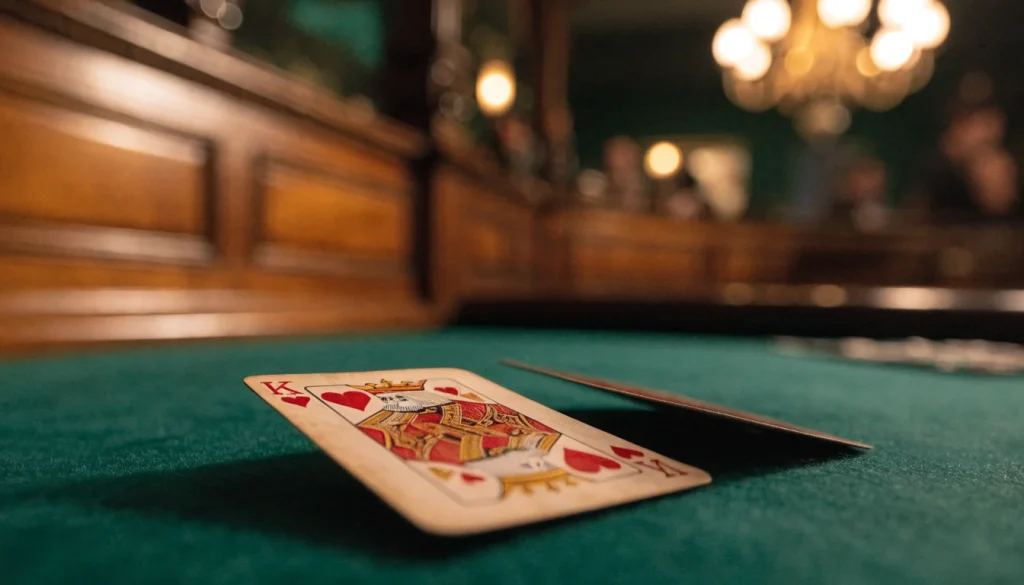
Hi-Lo turns a visible card into a prediction, while draw, live and reel formats can change the rules and pace.
Table of Contents
- The Card That Sets the Next Question
- How to Play a Draw Hi-Lo Round
- One Deck, No Second Appearance
- The Live Shoe and Its Unusual Rhythm
- Live Hi-Lo Online: What the Format Changes
- When Hi-Lo Runs on a Reel
- The Payout Table, Not a Lucky Hunch
- Playing Hi-Lo Online Without Blurring the Versions
- What a UK Hi-Lo Site Must Make Clear
- A Hi-Lo Casino Site and the Rules Around It
- Games
The Card That Sets the Next Question
Hi-Lo begins with a comparison, not a hand to build. A card is visible; the player must decide whether the next one will rank higher or lower. The question is plain enough to fit in a breath, which is part of the game’s appeal. It turns uncertainty into a choice with only a few doors, then makes the player live with the one selected.
The reference card does more than decorate the table. It sets the terms of the next decision. A low card makes “higher” seem inviting; a high one gives “lower” its moment. Yet the apparent simplicity is deceptive. The player is not choosing which card will appear, only predicting its relation to the card already shown. That distinction is the whole mechanism, and the small space it leaves for control is where suspense gathers.
Some versions add a third possibility: betting that the next card will have the same value. It is a different wager, not a softer form of either direction. The ordinary higher-or-lower choices point away from equality; the extra option names equality directly. Whether that choice exists depends on the version in play, so the label Hi-Lo does not, by itself, settle every rule.
When choosing a UK hi-lo casino in 2026, it helps to check the practical details available for each option. The payout information below gives a concise point of reference.
1. NightLuck
Payout speed: 1-3 business days NightLuck lists a payout speed of 1–3 business days.
2. Dieselwin
Payout speed: 1-3 business days Dieselwin lists a payout speed of 1–3 business days.
3. Jetsetspins
Payout speed: 1-3 business days Jetsetspins lists a payout speed of 1–3 business days.
4. Chanze
Payout speed: 1-3 business days Chanze lists a payout speed of 1–3 business days.
5. SpinFormula
Payout speed: 1-3 business days SpinFormula lists a payout speed of 1–3 business days.
6. WinBeast
Payout speed: 1-3 business days WinBeast lists a payout speed of 1–3 business days.
7. BeOnBet
Payout speed: 1-3 business days BeOnBet lists a payout speed of 1–3 business days.
8. EvoSpin
Payout speed: 1-3 business days EvoSpin lists a payout speed of 1–3 business days.
9. Revery Play
Payout speed: 1-3 business days Revery Play lists a payout speed of 1–3 business days.
10. NightWin
Payout speed: 1-3 business days NightWin lists a payout speed of 1–3 business days.
A matching card has a particular sting when the bet is higher or lower. If the next card matches the current one, either directional prediction loses. It is not a halfway result that rescues both sides, nor does the selected direction absorb the tie. The card has refused the comparison, and the wager has already committed to one. In that narrow sense, a draw is not neutral at all.
This is the detail that can make the game feel less like a coin toss with pictures and more like a test of how rules organise uncertainty. The player sees two broad directions, but the deck—or whatever arrangement the version uses—can produce a value that belongs to neither. A third betting option may address that possibility, while the basic higher-or-lower bets do not. The rules decide whether a tie is treated as a separate target or as a loss for both directional calls.
There is a small social history in such a design. Gambling often gives chance a vocabulary of apparent judgement: the player may assess, compare and choose, though the next card remains outside their command. Hi-Lo makes that bargain unusually visible. It does not ask for a theory of the whole game; it asks for one prediction, then another. The player’s agency is real, but carefully fenced.
That fence matters when comparing a Hi-Lo casino game with another bearing the same name. The central question remains higher or lower, but the available wagers and the treatment of a matching card must be read as rules of that particular version. A title can travel farther than its details. The same-card outcome is the clearest reminder: in the basic directional bet, equality is not a win for either side. A neat little trap.
Jackpot Mobile Casinos in the UK: How Prizes Work · Classic Slots Online in the UK: Free Play and Real Money
How to Play a Draw Hi-Lo Round
A draw Hi-Lo round begins with a card dealt at random. Its value becomes the reference point for the next decision: will the following card rank higher or lower? The player selects one of those directions and places a bet. When the starting card makes the outcome too uncertain to call with confidence, the choice is still a prediction, not a way to remove chance from the deal.
The next card settles the wager. A correct call earns a return according to the game’s pay table; matching the reference card results in a push, so the bet is returned rather than won or lost. A wrong call loses the bet and voids any winnings collected during that game. The distinction matters: a run of successful guesses does not create a protected balance within the round.
After the first decision, play can continue from the newly revealed card, which becomes the point of comparison for the next prediction. Each further choice therefore follows the same compact sequence: select higher or lower, see the card, and let the result determine what remains. The game’s pace comes from that repetition. No elaborate ritual, just another exposed value.
The player can stop after any decision and collect the winnings accumulated so far. Continuing offers another chance to build the total, but it also puts those collected winnings at risk if a later guess is wrong. Stopping is part of the round’s structure, not an afterthought. The pay table sets the return for a correct prediction; the player decides when the sequence has gone far enough.
Attention: A wrong call loses the bet and voids any winnings collected during that game, as a run of successful guesses does not create a protected balance.
One Deck, No Second Appearance
The draw version of Hi-Lo begins with an ordinary 52-card deck, but its most important feature is not what is in it. It is what cannot come back. Once a card has appeared, it is removed from play rather than returned to the pack. The deck therefore becomes a shrinking record of the game.
Its values run from ace at one point to king at 13. An ace stays low throughout; it does not change its rank to suit a later decision. Each card has a fixed place on that scale, giving the next comparison a simple vocabulary. The suits are part of the familiar pack, but the value sequence is what matters to a higher-or-lower choice.
That structure separates a draw Hi-Lo game from a format in which cards circulate through a shoe or shuffling system. Here, a card already seen is no longer among the possibilities. Nor can the same physical card appear twice in one game. It is a modest rule with a substantial consequence: the past remains in the deck’s arithmetic, rather than being swept away by a shuffle.
A fresh game restores the full pack; a continuing game does not. As cards leave, the possible outcomes narrow and the remaining composition changes. A high card already removed cannot be drawn again, just as a low card already dealt has left the pool. The game’s uncertainty is therefore finite, not reset after each reveal.
That makes this particular Hi-Lo game more than a sequence of isolated guesses. Every exposed card alters the set from which the next one must come. The rule does not make the next card certain, but it does make the history relevant. The deck remembers.
Fruit Machine Slots in the UK: How Digital Reels Work
The Live Shoe and Its Unusual Rhythm
Live Hi-Lo can look like a simple question asked of a card: will the next winning card sit higher or lower than the reference? The dealing sequence gives that question an unusual rhythm. The card that matters is not necessarily the next one physically drawn. In the described live format, three cards are burned before the next winning card is revealed, while the winning card from the previous hand remains exposed and becomes the reference for the following round.
That means the table presents two different kinds of information at once. One is visible and fixed: the previous hand’s winning card, which establishes the comparison point. The other is concealed in the shoe: the card that will eventually count for the new hand, after the burns. The choice is framed around the exposed card, but the sequence separating it from the next result is part of the game’s character.
The reported shoe is described as six decks of 48 cards, with tens omitted. It should therefore be read as a description attributed to that review, not as a verified specification for live Hi-Lo across casinos. The distinction matters. A description of one setup cannot quietly become a rule for every live table.
The absence of tens also changes the pack as described: it is not a standard full deck simply repeated several times. But the available account does not establish how every other card is arranged or how every live table handles its cards. The useful point is narrower: the reported format has a shortened deck, and its stated count remains uncertain. Precise-sounding numbers can give a game an air of settled machinery. Here, the machinery has a footnote.
The reported live shoe format uses six decks of 48 cards with tens omitted, though this specific setup may vary across different casinos.
The previous winner stays in view
After a hand produces its winning card, that card is left exposed. It then supplies the reference for the next round. This creates continuity between hands without making the next hand a continuation of the old one: a new prediction is made, but its starting point is inherited from the last result.
That visible carry-over is different from a fresh random starting card in a single-deck draw game. In the live sequence described here, the prior winning card is already known when the next question is posed. It is the marker against which the next winning card will be compared, not a card waiting to be drawn again from the shoe. The table’s display therefore does more than show what just happened. It carries that result forward as the next hand’s reference.
There is a small theatrical quality to this arrangement. The old result remains on display while the new one is still hidden, giving the table a visible memory. Yet it is a limited memory: the exposed card identifies the comparison point, while the dealing process moves on through the shoe. A neat visual cue, not a full account of what remains inside.
Three cards between question and result
The burn cards make the sequence less immediate than the language of “next card” might suggest. Before the next winning card appears, three cards are removed from view. The player’s prediction still concerns whether the winning card will be above or below the reference, but the reveal comes only after those intervening cards have been burned.
Video Slots in the UK: How Online Play Works
That interval is central to the live shoe’s rhythm. There is the exposed card, then the decision, then a pause in which the cards that do not count are dealt away, followed by the card that does. The burns are not additional outcomes to compare; they are part of the stated dealing procedure. Their presence separates the decision from the winning reveal and makes the physical handling of the shoe more prominent than in a straightforward draw.
The sequence also explains why a live table should not be imagined as merely a camera pointed at a single-deck game. The visible reference, the burned cards and the winning reveal form a specific order. The rules of higher or lower remain recognisable, but the path to the result is not identical to a draw game in which each card is simply turned over in sequence.
A shoe that keeps moving
The described setup uses a continuous shuffler. Cards from the previous round are returned to it straight away, rather than being set aside as a used group for the remainder of the session. The shoe therefore has a different relation to its recent past from the single-deck format, where used cards stay out of play.
That distinction affects how the table should be understood, not what can be inferred about a particular result. The exposed card remains the reference for the next hand, while cards from the earlier round re-enter the shuffling process. The three burns still precede the new winning reveal. These details belong together: one card is carried visibly forward, while the dealt cards are fed back into a system designed to keep the shoe moving.
Live Shoe Rhythm
- The previous winning card remains exposed as the reference for the next round.
- Three cards are burned before the next winning card is revealed.
- A continuous shuffler immediately returns used cards to the shoe.
Live Hi-Lo’s unusual rhythm lies in that contrast. The table remembers one card in public, hides three others before the next result, and returns the previous round’s cards to the shuffler. What can be described is the sequence itself: reference, burns, winning card, and cards back into motion.
The rhythm is the rule’s furniture.
Live Hi-Lo Online: What the Format Changes
The central question survives the move to a live online format: will the next card rank higher or lower than the one serving as the reference? The setting may change how cards are handled, but it does not turn Hi-Lo into a different kind of prediction. Some versions also allow a wager on the same value, though that option belongs to the particular rules in use, not to every game carrying the name.
That continuity can make live Hi-Lo seem simpler than it is. The choice is familiar; the card supply is not necessarily managed in the same way as in a single-deck draw game. In the live format described here, a continuous shuffler is used, and cards from the preceding round are returned to it immediately. The deck is therefore not a shrinking record of what has already appeared in the game.
This distinction matters because memory can acquire an undeserved air of authority. In a single-deck game, a card that has appeared cannot appear again during that game. In a live game with cards promptly returned to a continuous shuffler, that same assumption does not apply. A previous card may still be part of the equipment’s wider supply, rather than permanently removed from consideration. Counting what has appeared is not automatically a map of what remains.
Chicken Road Game in UK Casinos: What to Know
The prediction itself stays concrete. A player considers the reference card and chooses whether the next one will be higher or lower, with a same-value option where the rules provide it. But the meaning of “next” depends on the format’s handling of cards. A sequence can look like a trail through a deck while functioning quite differently from a single, finite run of cards. The eye likes a pattern; the machinery need not agree.
For anyone comparing live Hi-Lo casino sites, the useful question is not whether a game looks familiar on screen, but what its rules say about the card supply and the available predictions. A shared name is not a guarantee of shared mechanics. One game may make the same-value choice available; another may limit the decision to higher or lower. Likewise, a live presentation should not be treated as evidence that cards stay out of play after appearing. The handling rule does that work.
There is a small social history in this difference. Card games have long made uncertainty feel negotiable: a player sees a card, weighs a choice, and tries to make the unknown seem orderly. A single-deck format gives that effort a visible boundary, because cards leave the pack as they are used. A continuous shuffler gives the game another rhythm: the previous round’s cards return to the process rather than forming a steadily depleted pile. The decision remains human-sized. The supply does not.
That is why live Hi-Lo online can be approached as a question about format before it becomes a question about judgement. The higher-or-lower choice remains the game’s centre, but the relationship between past cards and future ones changes when used cards return to the shuffler. It would be a mistake to carry every inference from a draw game into a live shoe simply because both ask for a prediction.
Do
- Check the rules regarding card supply and available predictions.
- Distinguish between single-deck and continuous shuffler formats.
Don’t
- Assume a shared game name guarantees identical mechanics.
- Apply card-counting inferences from draw games to live shoes.
A live Hi-Lo online casino in the UK may present this familiar choice in a different card-handling arrangement, but the name alone cannot settle the rules. The point is not that one format makes prediction easy. Neither does. It is that each format gives the past a different role: in one, a card can be gone for good within that game; in the described live setup, cards from the previous round go straight back into the continuous shuffle. Familiar question. Different memory.
When Hi-Lo Runs on a Reel
Not every Hi-Lo game asks a player to compare one card with the next. A reel-based version turns the same directional idea into a choice about where a single reel will stop. The player selects higher or lower, then the result is judged against that direction. It is a small change in apparatus, but a substantial one in the feel of the game: the question is no longer what the deck contains, but where the reel settles.
A specialist review describes the wager as a win when the reel stops on a number in the chosen direction. A stop in the opposite direction loses, and a tie also counts as a loss. That last condition removes the neutral pause available in some card formats. The reel offers no push on equal values in this account; its middle ground belongs to the house.
The choice is deliberately spare. Higher or lower. Yet the apparent simplicity should not be mistaken for a universal rulebook: this is a particular reported reel format, not a definition of every Hi-Lo casino game. The mechanics of a card draw, where an exposed value sets the next comparison, should not be silently carried over to a reel. Here the decision concerns the reel’s eventual number, and the outcome follows its direction relative to the selection.
Plinko Casino in the UK: Rules, Offers and Payments
A win creates a second decision. As described in the specialist review, the player may collect the return and begin again, or parlay the original stake together with the winnings into another attempt. Collecting closes the sequence; parlaying keeps it alive, with the accumulated result exposed to the next outcome. A wrong guess voids all winnings collected in that game, so a growing total is not the same thing as a secured one. The distinction is plain, if not especially comforting.
This is where the reel format acquires its own rhythm. The first choice is directional; the next is about whether to leave with the win or put it back into play. The latter choice does not change the reel’s odds or make a prediction more informed. It changes only what is at risk in the continuing run.
For anyone comparing a hi lo game casino format with the card versions, that separation matters. A reel’s tie is a loss under this described rule, and its post-win parlay option is a separate feature of the reported format. Neither detail should be assumed of a game simply because Hi-Lo appears in its name. The label travels more easily than the rules.
The Payout Table, Not a Lucky Hunch
Hi-Lo gives chance a tidy appearance: a card lies face up, and the next one is asked to go higher or lower. But the decision is not simply a matter of instinct. Each option has a price, and the payout table is the part that tells a player how the game values a prediction.
For Higher or Lower bets, the recommended approach is to select the choice that offers the higher payout based on the pay table.
For a Higher or Lower bet, the stated recommendation is to take whichever choice pays more. That is a comparison of potential returns, not a promise that the more generous option will win. A larger payout can reflect a less likely outcome; a smaller one can accompany an outcome that is easier to predict. The table, rather than a feeling that a run is “due”, is the useful evidence at the moment of choice.
That distinction matters because Hi-Lo invites stories. A sequence of cards can seem to be forming a pattern, and the next decision can acquire a little drama. The deck, however, does not recognise a narrative. The payout table records the terms on which the game offers each prediction; it does not reward confidence for its own sake.
A specialist review reports a highest return of 96.23% for the described game when betting Higher than 4 or Lower than 10. The figure belongs to that stated approach and game, not to every Hi-Lo table or every version carrying the name. It is also a theoretical return, not a forecast for an individual session. A player can win or lose in the short term; a percentage cannot say which.
Highest RTP Slots in the UK: How Returns Work
The same specialist review gives a 96.07% return for basic strategy. The narrow gap between that figure and the reported high point is less exciting than the idea of a perfect hunch, but more useful: the difference comes from the stated betting choices, not from a secret ability to read fate. A payout table can make one option comparatively attractive without changing the essential uncertainty of the next card.
Card counting is reported separately, with a return of 100.36%. That number should be kept especially close to its conditions. It is attached to a card-counting strategy for the described game, rather than being a general property of Hi-Lo or a dependable result for anyone who keeps a mental tally. The apparent edge is a calculation, not a guarantee. Different rules, pay tables or card handling can change what the calculation means.
There is a familiar temptation in a figure above 100%: to read it as a reliable route to profit. That is not what a theoretical return establishes. It describes an expected relationship between stakes and returns under a particular model of play over repeated decisions. It does not ensure that the model applies to another game, nor that an individual will experience its average. A number can be precise and still have a narrow jurisdiction.
The comparison between basic play and counting is therefore not a ranking of casino sites. It is a comparison of strategies within the described game. Basic play follows the recommended choice between the available Higher and Lower payouts. Counting attempts to use information from cards already seen. Neither method turns a random draw into a certainty, and neither can be assumed to transfer unchanged to another format.
The table also deserves attention for what it does not say. A generous payout on one side does not mean that side is more likely; the two are different measures. The return figures do not describe a player’s likely result on a particular night, and they do not erase the possibility of loss. They are best read as the arithmetic attached to a specific set of rules, not as a promise hidden in the small print.
Caution: Theoretical return percentages, such as those for basic strategy or card counting, are not guarantees of individual session results.
That is less romantic than a lucky hunch. It is also more honest.
Playing Hi-Lo Online Without Blurring the Versions
“Hi-Lo online” can describe games that share a prediction but not the same way of settling it. In one account, a correct call adds winnings to a running pot, while a wrong call loses the money staked. Another description uses a pay table: a correct prediction is paid according to the listed return, a tie is a push, and an incorrect prediction loses. Those distinctions change what a win means. A growing pot and a table-set payout are not interchangeable labels for the same reward.
The loss condition matters just as much. In the pot-based version, a wrong prediction forfeits the amount placed on that call; the winnings already gathered in the game are also void. A run can therefore look substantial and still end with nothing if the next guess fails. In the pay-table version, the stated outcome for a tie is different: the stake is returned rather than treated as a win or a loss. The table, not a general idea of how Hi-Lo ought to work, settles the result.
Even the pack is not consistently described. One account specifies a single deck of 52 cards, with used cards kept out of play. Another describes six decks of 48 cards, continuously shuffled. These are materially different arrangements, not minor variations in presentation: in one, a card already seen cannot recur during that game; in the other, cards return through a continuous shuffler. The descriptions disagree, so neither arrangement should be treated as the defining format for every online Hi-Lo game.
Online Bingo UK: Formats, Tickets and Slot Offers
That uncertainty is useful to keep in view when comparing online versions. A familiar name can conceal different rules for accumulation, ties and the cards available for later calls. The game’s central idea survives those changes—predict whether the next card is higher or lower—but the consequences attached to the prediction do not necessarily travel with it. A player moving between interfaces may recognise the choice and still be facing a different settlement system.
This is less a defect of the name than a reminder of how casino games are packaged. A simple mechanism can be made legible in a few seconds; the fine print of its economy takes longer. One format lets a run build into a pot, another applies a payout schedule and preserves the stake on a tie. Neither description licenses assumptions about the other. Small distinctions, real money.
For anyone assessing a particular hi lo online casino, the useful comparison is therefore not merely the graphics or the speed of a round. It is the rules that determine what happens after each call: whether a tie pushes, how a correct guess is credited, what a failed guess removes, and how the deck is handled. The version’s own rules should answer those points before play begins. The shared name is only a beginning.
What a UK Hi-Lo Site Must Make Clear
A Hi-Lo game may look like a small contest between a player and a card, but the site offering it sits inside a much larger arrangement of public rules. In Great Britain, the UK Gambling Commission is the sole regulator for commercial gambling, including online casinos. Its reach does not depend on where a casino’s servers or other key equipment are located: remote gambling offered to consumers in Great Britain falls within its remit.
Licensing Check
Ensure the casino holds a valid operating licence from the UK Gambling Commission by verifying its licence number on the public register before depositing funds.
The Commission issues operating licences to gambling businesses and personal licences to individuals carrying out regulated roles. For a casino, the operating licence is the essential permission to offer gambling to the public. A polished website, a familiar payment logo or a catalogue of recognisable games cannot substitute for it. Formalities matter.
Before depositing, the licence number should be checked against the Commission’s public register. The register is the practical point of reference for confirming that the business named on a site holds the relevant licence. A licence claim printed on the site is not independent confirmation; it is a claim made by the very business being checked. Hi-Lo casino sites serving Great Britain should make their licensed status identifiable rather than leaving visitors to infer it from branding or presentation.
Age checks are also part of the threshold, not an optional courtesy after play has begun. Operators must verify a customer’s age before allowing a deposit into a gambling account. Online gambling is legal for adults aged 18 and over when it is offered by an operator holding the appropriate UK Gambling Commission licence. That sequence matters: age verification comes before the money enters the account.
High-Volatility Slots in the UK: How They Work
There are protections inside the account as well. Remote operators must prompt new customers to set a financial limit before their first deposit and provide accessible controls for managing limits at account level. These controls give a player a way to define boundaries; they do not turn a game into a predictable expense. A limit is a safeguard, not a forecast.
Responsible-gambling tools must also be available through UK-licensed casinos. Their presence is part of the regulated service, not decorative text in a footer. The Commission also requires operators to contribute to the Research, Education and Treatment levy, placing some responsibility for gambling-related harm on the businesses that profit from the activity.
The legal framework is not simply a seal attached to a game. It establishes who may offer remote gambling to people in Great Britain, what status the operator must hold and which basic controls belong around the account. The distinction is plain enough: the game asks higher or lower; the regulator asks who is permitted to deal.
Best RTP Casino Slots UK: What the Figures Mean
A Hi-Lo Casino Site and the Rules Around It
A casino account is not only a doorway to games; it is also where some of the protections required of a UK-licensed operator become practical. The UK Gambling Commission oversees gambling in the country, online casinos included. That oversight matters most when play stops being a private transaction and becomes a dispute, a request to block access, or a question about how funds entered the account.
Self-exclusion is one such safeguard. UK-licensed casinos must provide it, alongside other responsible-gambling tools. GAMSTOP is a separate self-exclusion programme for online gambling. These measures are intended to make a decision to step away more than a passing instruction to oneself. The account-level controls matter too: operators must make financial-limit tools accessible and prompt new customers to set a limit before their first deposit.
Complaints have a route as well. A licensed operator must offer an internal complaints process, and access to an approved Alternative Dispute Resolution service. The first stage is the casino’s own procedure; if the matter remains unresolved, ADR provides an external avenue. That structure does not promise that every complaint will be upheld. It does mean that a disagreement need not end with the operator’s final word.
Payment restrictions draw a firm line around borrowed credit. UK-licensed casinos cannot accept credit cards for gambling. The prohibition also covers credit-card funding channelled through a money service business, and wallets that allow credit-card funds to be used for gambling. A payment method’s familiar name does not change the source of its money. Credit remains credit.
These safeguards are more useful when checked before an account becomes a habit: the self-exclusion options, the limit controls, and the complaints route should be visible in the site’s terms or help pages. If the operator’s process does not resolve a complaint, the approved ADR service is the next formal step. A regulated casino is not exempt from friction. That is the point.
Games

Aviator Casino Game UK: Licensing and Play
A guide to the UKGC divide, crash-game play, bonus terms and payment considerations around Aviator....

3-reel slots in the UK: how online play works
Three-reel games echo older machine formats, but online play operates within a regulated market and...

Five-Reel Slots in the UK: Free Play and Features
Five-reel layouts, demo play, bonus features and session costs are considered alongside a brief comparison...

Bonus Buy Slots in the UK: How the Feature Works
A bonus buy enters a slot’s bonus stage directly, while the game’s own bonus rules...

Keno Payouts vs Fast Casino Withdrawals in the UK
Keno’s return figures describe the game’s long-run structure, while withdrawal timing is separate from the...

First Deposit Bonus Casinos in the UK: How Offers Work
A first deposit is your own money; any welcome promotion is separate and follows the...

High-Volatility Slots in the UK: How They Work
Volatility describes how often wins arrive and how large they tend to be, but it...

Keno Online Casinos in the UK: Draws and Odds
Keno pairs a numbered card with a separate random draw; game variants, payouts and play...

Live Casinos in the UK: How Tables and Offers Work
Live casino play combines a filmed physical table with software for wagers, choices and outcomes,...

Low-Volatility Slots UK: How Their Payouts Work
Low volatility describes a pattern of smaller, more frequent wins, but it cannot predict a...

Online Slots Payout Percentages: How They Work
A game’s return depends on its rules and paytable, while volatility and individual results answer...

Progressive Jackpot Slots: How the Pools Grow
See how wagers feed progressive pools and how jackpot routes, game availability, RTP and bet...

Best RTP Casino Slots UK: What the Figures Mean
RTP describes a theoretical long-run return, while volatility and session length shape how results may...

Video Slots in the UK: How Online Play Works
Explore how screen-based reels, symbols and software combine to determine slot outcomes and shape the...

Casino dice games in the UK: how online play works
Digital dice games link a stake to a defined random outcome, while the display may...

Chicken Road Game in UK Casinos: What to Know
The article considers how casino labels, availability and game formats shape what can reasonably be...

Classic Slots Online in the UK: Free Play and Real Money
See how demo play introduces reels and controls, and how it differs from the conditions...

Crash Casino Games in the UK: Rules and Play
The guide explains licensing context, casino advantages, game verification, demo limits, payments and the terms...

Crazy Time Live Casino Game Show in the UK
The guide distinguishes the studio stream from digital controls and examines casino conditions, roulette, demos,...

Deal or No Deal Casino UK: How the Slot Works
Follow the game from opening cases to the final decision, and see what can—and cannot—be...

Fastest Payout Online Casinos in the UK: Evidence
A quick game result and a completed casino withdrawal are separate events, and the available...

French Roulette Online Casinos in the UK: Rules
French roulette’s zero rules affect eligible bets, while table pace, format and bonus terms shape...

Fruit Machine Slots in the UK: How Digital Reels Work
A guide to the shift from pub cabinets to software-led games, including reels, randomness, bonuses...

Highest RTP Slots in the UK: How Returns Work
A practical explanation of theoretical returns, volatility and why a published percentage cannot predict an...

Jackpot Mobile Casinos in the UK: How Prizes Work
Progressive, fixed, must-drop and network jackpots work differently, and their prize structures sit alongside UK...

JetX Casino Game in the UK: How It Is Classified
JetX is often discussed alongside slots, but a category label alone does not explain its...

Live Baccarat Online Casinos in the UK: What to Check
See how live baccarat differs from digital games, and what to consider about table limits,...

Live Blackjack Online Casinos in the UK
A closer look at licensing, live table formats, blackjack rules, side bets, bonuses and limits...

Live Dream Catcher Casino UK: Game and Site Guide
A clear look at the streamed dealer format, game mechanics and the limits of what...

Live Casino Lightning Roulette in the UK: Rules and Play
The guide covers UK licensing, live-dealer play, roulette odds, demo limits and the differences between...

Live Roulette UK: How the Live Table Works
Live roulette streams a dealer and physical wheel, while digital betting controls and game mechanics...

Mines casino game in the UK: play and licensing
A guide to free play, casino offers, randomness and the UK licensing line around online...

Monopoly Live Casino UK: How the Live Format Works
A practical guide to streamed play, roulette mechanics, demo limits and the bonus conditions that...

Online Bingo UK: Formats, Tickets and Slot Offers
A guide to bingo formats, prize structures, free play and how slots fit into UK...

Online American Roulette in the UK: How It Works
The extra 00 sets American roulette apart, shaping the wheel layout, bet outcomes and the...

European Roulette at UK Online Casinos: How It Works
A practical guide to single-zero roulette, from bet types and online formats to bonuses and...

Online Casino Games for Real Cash in the UK
A clear guide to how real-money spins work and why a displayed win, a bonus...

Online Casino Tournaments UK: Entry and Rules
Tournament terms distinguish no-cost entry from ticketed or paid access, while scoring, prizes and opt-in...

Online casinos without ID in the UK: what it means
The label may describe when or how documents are requested, but it cannot remove identity...

Penny Slot Machines in the UK: Stakes and Play
A practical guide to minimum spin costs, practice play, RTP, bonus terms and checking which...

Plinko Casino in the UK: Rules, Offers and Payments
Plinko is a game category, but an operator’s UKGC status shapes its regulatory position, while...

Progressive Slots Online in the UK: How Jackpots Work
Progressive jackpots grow through contributions from qualifying wagers, with the displayed pool changing as connected...

UK Casino Slots: Licensing, RTP and Bonus Terms
A practical guide to licensing, slot odds, bonus conditions and the checks that matter before...
































































































































































































































































