
Credit Card Deposits at UK Casino Sites Explained
 Available in GB
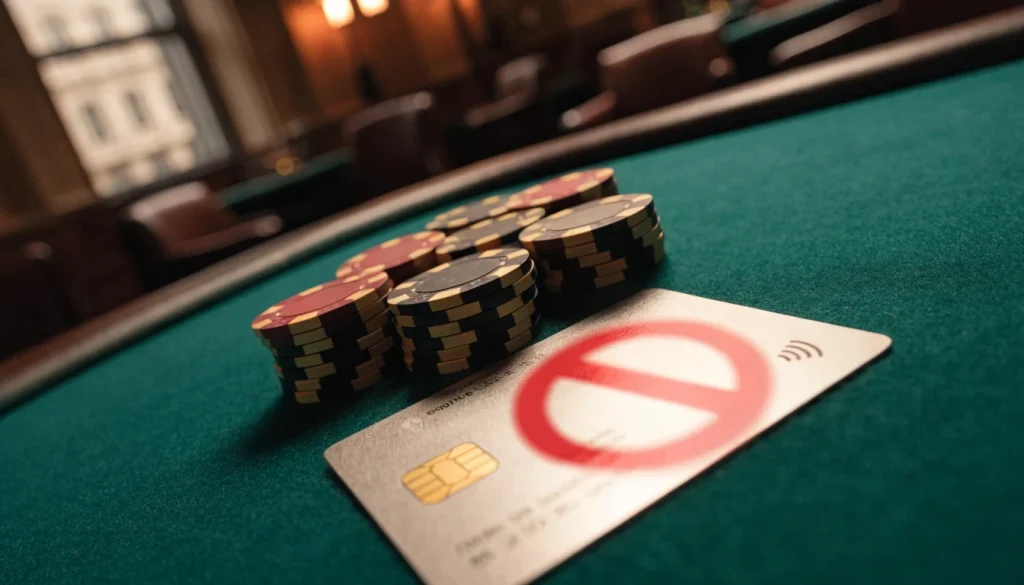
UK-licensed operators cannot take credit-card funds for gambling, even when a payment is presented as an account deposit.
Table of Contents
- Can UK Casinos Take Credit Card Deposits?
- Why the 2026 Search for Credit Card Casinos Comes Up Empty
- What “Best” Means When Credit Cards Are Off the Table
- Deposits, Withdrawals and the Route Money Takes Back
- Paying by Credit Card: The Ban and Its Boundaries
- The Payment Methods UK Casinos Actually Use
- “Not on Gamstop” Does Not Make Credit Cards an Option
- When the Credit Card Gambling Rule Began
- A Credit Card Casino in the UK: The Safer Payment Route
- Online Slots Without Credit Card Deposits
- Payments
Can UK Casinos Take Credit Card Deposits?
No. A UK-licensed casino cannot accept a credit card deposit for gambling. The same answer applies whether the intended play is table games, online casino games or slots: credit-card payments are not an allowed way to fund gambling with a UK-licensed operator.
That can seem an oddly narrow rule. A credit card is an ordinary payment tool in many parts of daily life, and a casino cashier may present several ways to add money. But the category of payment matters. A credit card does not become acceptable simply because the transaction passes through a familiar checkout screen or is described as a general account payment. For gambling at a UK-licensed casino, the answer remains no.
This applies to online play as much as to a visit to a casino. A player cannot use a credit card to deposit into an online casino account and then use that balance for slots. Nor can a casino make the transaction permissible by calling it a gaming balance or treating it as separate from the games. The essential point is the purpose of the payment: credit-card funds cannot be used for gambling at a UK-licensed site.
The rule is not a preference set by an individual casino. Remote gambling licensees serving the British market must operate within the conditions imposed by the UK Gambling Commission. A site holding the relevant licence cannot choose to accept credit cards because customers request them, because a payment provider offers them, or because a card brand appears among the payment logos. The restriction applies to the operator’s gambling service.
There is a difference between a card being familiar and a card being available for a particular transaction. Payment pages can make the distinction look less clear than it is: logos are often used to signal broad payment support, while the cashier determines what a customer can actually use. For credit cards, however, there is no permitted deposit route at a UK-licensed casino. A logo or a general claim about card payments cannot overturn that.
Jeton casino sites in the UK: availability and payments
The phrase “casino sites that accept credit card” therefore does not describe a legitimate option within the UK-licensed market. A site may use language that sounds welcoming, or a payment page may look much like one used for ordinary online shopping. Neither changes the rule. A UK-licensed casino cannot accept the card for gambling deposits.
This is why the answer to whether credit cards can be used at an online casino in the UK is not dependent on the game selected. Slots do not create an exception. A credit-card deposit cannot be made acceptable by directing the money to a slot balance rather than another casino game. The restriction concerns gambling payments, not the particular game that follows.
The distinction matters because a rejected or unavailable payment method is not merely a technical inconvenience. It reflects the boundary within which licensed gambling is permitted to operate. UK gambling regulation does not treat every method of moving money as interchangeable, even when the customer sees only a few buttons on a screen. A licensed casino must respect that boundary.
So the practical answer is firm: credit cards cannot be used to deposit at a UK-licensed casino, online or otherwise. A site offering real-money gambling to customers in Great Britain must hold a UK Gambling Commission licence, and that licence does not allow it to take credit-card payments for gambling. The payment label may vary. The rule does not.
Why the 2026 Search for Credit Card Casinos Comes Up Empty
The phrase “credit card casino” suggests a simple filter: find a UK casino, choose a card, make a deposit. For a UK-licensed casino, that description cannot match the payment route. Credit-card payments for gambling are not accepted, so a site cannot accurately be presented as a UK-licensed casino that takes credit cards for deposits.
That leaves a gap between the words people use and the options actually available. “Card” can mean more than one thing. A payment page may name Visa or Mastercard without establishing that every product carrying those brands can be used. A debit card and a credit card are not interchangeable just because they share a logo. The distinction matters at the point where the payment is made, not merely in a site’s promotional description.
Attention: A payment logo on a site may refer to a card brand generally, but it does not prove that credit-card deposits are permitted for UK customers.
A specialist review may list Visa and Mastercard among a casino’s payment options. That is a clue to check, not proof that a particular card product is eligible in the UK. Current availability and card eligibility need to be confirmed in the casino cashier. The cashier presents the options for that account and transaction; a logo elsewhere on the site cannot settle the question.
This is why a list of “UK casinos that accept credit cards” is liable to mislead even when it looks precise. A payment logo might refer to a card brand, not to credit-card funding. It may also describe a method without making clear whether it is currently offered to a UK customer. The distinction between a brand appearing on a page and a specific deposit being accepted is practical, not semantic.
The same caution applies to searches for online casinos or slots that take credit cards. Slots do not have their own payment arrangements: the account holding the casino balance is funded through the operator’s cashier. Changing the game does not change what payment method the operator may accept. A slot title, game category or “casino” label cannot turn a prohibited credit-card deposit into an available one.
The useful question, then, is not whether a page has a familiar card logo. It is what the cashier actually offers, and whether the displayed card option refers to a permitted card product. If the cashier does not show an eligible route, a logo in a review or a general payments panel does not fill the gap. Nor does the year in a page title: 2026 does not make a restricted deposit method newly available.
A search can still return pages that use broad card language. That wording may be convenient for describing brands, but it does not establish that a credit card can fund gambling at a UK-licensed casino. The label needs to be read narrowly, against the actual payment screen. In this case, a familiar logo is not an answer.
The cashier is the test.
What “Best” Means When Credit Cards Are Off the Table
If you’re looking for UK casino sites that accept credit cards, it’s worth checking what each option offers before choosing. This list provides a concise reference point, including the stated payout speed for each site.
1. NightLuck
Payout speed: 1-3 business days NightLuck lists a payout speed of 1–3 business days.
2. Dieselwin
Payout speed: 1-3 business days Dieselwin lists a payout speed of 1–3 business days.
3. Jetsetspins
Payout speed: 1-3 business days Jetsetspins lists a payout speed of 1–3 business days.
4. Chanze
Payout speed: 1-3 business days Chanze lists a payout speed of 1–3 business days.
5. SpinFormula
Payout speed: 1-3 business days SpinFormula lists a payout speed of 1–3 business days.
6. WinBeast
Payout speed: 1-3 business days WinBeast lists a payout speed of 1–3 business days.
7. BeOnBet
Payout speed: 1-3 business days BeOnBet lists a payout speed of 1–3 business days.
8. EvoSpin
Payout speed: 1-3 business days EvoSpin lists a payout speed of 1–3 business days.
9. Revery Play
Payout speed: 1-3 business days Revery Play lists a payout speed of 1–3 business days.
10. NightWin
Payout speed: 1-3 business days NightWin lists a payout speed of 1–3 business days.
“Best” cannot mean a casino that accepts a credit-card deposit when that route is not available at UK-licensed casinos. The useful comparison begins elsewhere: with the payment methods a site actually offers, the terms attached to them and how well they fit the rest of its service. A familiar logo is not a verdict.
Debit cards are a practical starting point. UK casinos commonly accept Visa and Mastercard debit cards, but that does not make every card product interchangeable or every cashier identical. A payment option matters only when it is available for the account in question and its conditions are clear. The name on a banner may describe a broad payment brand, not a promise about every card issued under it.
That distinction changes the idea of a “best” casino. The label cannot be earned by claiming a credit-card facility; it depends on whether the available route is usable and whether its terms suit the customer. A site that displays a recognisable method but leaves its conditions obscure has offered a logo, not much guidance.
A payment method that appears attractive in isolation, such as PayPal, may not qualify for certain casino bonuses depending on the individual offer’s terms.
Payment convenience also has limits. A specialist review has described PayPal as popular for speed and convenience, while noting that it may not qualify for bonuses. That is a reported assessment, not a fixed rule across UK casinos: promotion terms can differ, and the relevant conditions belong to the individual offer. A payment method that seems attractive in isolation may therefore be less useful to someone who is weighing a promotion as part of the overall choice.
The same caution applies to comparisons built around a single feature. A quick-looking payment route is not automatically the best fit if its terms conflict with a bonus, while a widely recognised card brand does not establish that the precise card will work. The comparison has to be made at the level of the actual cashier and the actual terms, not through a general label attached to a site.
There is a small social history in this change of emphasis. Credit cards once suggested a tidy separation between purchase and payment, with the bill arriving later. For gambling, that familiar convenience is precisely what the UK system has removed from the licensed route. The market’s comparison now turns on a less glamorous question: which permitted method is available, understandable and compatible with the conditions attached to play?
That is a narrower promise than “best credit card casino”, but a more honest one. No ranking of operators is needed to make the point. A useful standard is simply whether the payment information is clear enough to compare, whether the chosen method appears in the cashier, and whether its terms align with any promotion being considered. The method, not the marketing language, decides the practical value.
UK Casino Sites That Accept EcoPayz: Payment Guide
The phrase “best” survives, then, only after its premise has changed. It describes a comparison among available payment routes and their conditions, not a hunt for a credit-card exception. In a regulated market, that distinction is not pedantry. It is the difference between an attractive claim and a usable choice.
Deposits, Withdrawals and the Route Money Takes Back
Money rarely travels through a casino account in one uninterrupted movement. A deposit may appear promptly, while a withdrawal has to pass through a separate sequence of checks and approvals. The visible balance is therefore not a reliable clock for how soon funds will reach a bank or payment account.
A specialist casino review describes a permitted card deposit as potentially instant, with a payout taking several business days. The difference is not necessarily a contradiction. Deposits and withdrawals travel in opposite directions and face different checks: a payment entering an account is not the same transaction as winnings leaving it.
The casino’s own processing stage matters. A withdrawal request may wait for internal approval before the payment provider or bank handles it. Specialist reviews also note that an initial withdrawal can take longer when verification is still being completed. This is where KYC becomes part of the transaction rather than a formality detached from it: the operator needs to establish who owns the account and whether the requested payment belongs on the route being used.
Why withdrawals may take longer
Withdrawals often require internal casino approval and KYC verification to establish account ownership and ensure the payment belongs on the chosen route.
Then comes the return journey. UK anti-money-laundering controls commonly require payouts to go back to the original payment source. The rule is often described as a closed-loop approach: funds return along the route by which they entered, rather than being sent wherever a player happens to nominate later. It makes the path easier to audit and can help prevent another person’s account or payment instrument from becoming part of the transaction.
That can affect which withdrawal route is available. A deposit method may not support withdrawals, or an operator may need to return funds to the source first and handle any remaining balance through another approved route. The cashier’s options and the operator’s terms determine the practical sequence; a payment logo alone says little about what happens after a win.
A request to withdraw by a different method can also prompt further checks. That does not automatically mean something has gone wrong. The operator may need to confirm ownership or ask for additional verification before releasing funds. Details that match across the gambling account and payment account reduce avoidable friction, while a mismatch can turn a straightforward request into a review.
The total wait is consequently made up of more than a bank transfer. It can include the casino’s approval, completion of verification and the time taken by the payment service to deliver the funds. Those stages are not interchangeable, and the operator’s estimate may refer to only part of the journey. A status marked as approved, for instance, does not necessarily mean the receiving bank has already made the money available.
Wirecard Casinos in the UK: Checking Payment Access
The same distinction applies when comparing casino sites that accept credit card deposits in the UK: the speed of a deposit is not a measure of withdrawal speed, and a credit card is not an available gambling deposit route at a UK-licensed casino. The useful comparison is between the payment route the cashier actually permits and the route the operator will use to return funds.
Before a transaction, the cashier and payment terms are the places to establish whether the chosen method supports both directions, what verification may be required and whether the account currency matches. This is less glamorous than a promise of instant money. It is also the part that determines where the money goes.
Paying by Credit Card: The Ban and Its Boundaries
The UK restriction is not confined to a card number entered directly into a casino cashier. It follows the money when a credit-card payment is routed through a money service business. In other words, adding an intermediary does not change the character of the payment: if credit-card funds are being used for gambling, the route does not make that payment acceptable to a UK-licensed remote gambling operator.
That boundary matters because payment systems often present several steps as separate transactions. A card may fund an account or service, which then passes money to a gambling account. From the player’s point of view, the casino might never see the card details. From the regulatory point of view, the relevant question is still whether the gambling payment is being funded by credit. A change of interface is not a change of substance.
Prohibited Routes
Using a money service business or a digital wallet to route credit-card funds into a gambling account is not a permissible way to bypass the UK credit card ban.
Wallet payments have a related restriction. A digital wallet is not automatically a permitted detour simply because it is a wallet rather than a card. Where the wallet allows credit-card funds to be used for gambling, a remote gambling licensee cannot accept that payment. The rule concerns the funding route, not the label attached to the final button.
This does not mean that every wallet is prohibited, or that a wallet funded from a permitted source is necessarily treated as a credit-card payment. The distinction is specific: credit-card funds must not be available through the wallet for gambling. Payment options can therefore depend on how a wallet account is funded and what its terms allow. A familiar logo alone says little about that boundary.
The same care applies to intermediaries described as payment services. A service that transfers money does not cleanse its origin. If a credit card is used upstream to make gambling funds available, placing a payment provider between the card issuer and the casino does not turn the transaction into an ordinary bank transfer. The route can be longer; the restriction remains.
For licensed operators, this is a limit on what they may accept, rather than a puzzle for customers to solve by trying different combinations. A failed transaction may reflect a card issuer’s controls, the payment provider’s rules or the operator’s own cashier settings, but none of those outcomes creates an authorised credit-card route. Nor does the absence of a direct card charge establish that a wallet-funded payment is allowed.
Casinos That Accept Citadel in the UK: What to Check
The practical boundary is therefore broader than “no credit card details in the deposit form”. It also covers gambling payments routed through a money service business and wallet payments where credit-card funds can be used. That is the point at which a payment method’s structure matters more than its name. Intermediaries do not make the rule disappear.
The Payment Methods UK Casinos Actually Use
Once credit cards are set aside, the cashier becomes a catalogue of different payment routes rather than a simple list of interchangeable buttons. A method may accept deposits but not withdrawals; another may be available only to some customers. The label alone does not describe the whole journey.
Debit cards
Visa and Mastercard debit cards are commonly accepted by UK casinos. They provide a direct card-based way to fund an account, but the cashier should still be checked for the particular card product and for whether it supports payouts as well as deposits. A payment logo on a general page is not a promise that every card will work for every transaction.
Some UKGC-licensed casinos also offer Apple Pay for deposits. Its presence does not establish that withdrawals can be sent back through the same route. That distinction matters: the deposit button is only one half of the payment arrangement.
Bank transfers and open banking
Bank transfers and open-banking services connect the casino payment to a bank account. A specialist review describes these routes as capable of providing instant deposits and fast withdrawals at many sites; that is a report about availability, not a guarantee for every cashier or account. The service offered by a particular casino is decisive.
Debit Cards
Visa and Mastercard debit cards are commonly accepted for funding accounts and payouts.
Bank Transfers
Direct connections to bank accounts that can provide instant deposits and fast withdrawals.
Prepaid Vouchers
Deposit-only options like Paysafecard that allow users to set a firm boundary on funds.
E-wallets
Services such as PayPal, Skrill, and Neteller, though availability and bonus eligibility vary.
“Bank transfer” can cover more than one payment flow, so the name may not tell whether a withdrawal is supported. The cashier’s deposit and withdrawal screens are more informative than a generic list of methods.
Prepaid vouchers
Paysafecard is a prepaid voucher, and its role is deposit-only. It can put a firm boundary around the amount loaded through that voucher, but it is not a route for receiving casino winnings. A separate withdrawal method may therefore be needed, subject to the casino’s rules and any verification it requires.
E-wallets
PayPal, Skrill and Neteller are names that may appear among e-wallet options, though availability differs between casinos. One specialist review reports Skrill and Neteller as available at some sites and often excluded from promotions. Bonus terms need to be read alongside payment terms: an accepted deposit method does not necessarily qualify for every offer.
The practical comparison is not simply which method appears quickest or most familiar. It is whether the account can use it for the intended transaction, whether the casino supports withdrawals through it, and whether any promotion treats it differently. Even within one category, the answer can vary by operator and account. A payment menu is a map, not a universal rulebook.
“Not on Gamstop” Does Not Make Credit Cards an Option
A casino’s Gamstop status and its permission to accept credit-card payments for gambling are separate matters. The first describes a relationship with a self-exclusion scheme; it does not create a payment exemption, establish a gambling licence or tell a player which rules govern the operator.
Casinos That Accept Upaycard in the UK: What to Check
For a remote gambling licensee serving customers in Great Britain, the credit-card restriction applies regardless of whether the casino is described as being on Gamstop. A licensed operator cannot make credit-card gambling payments acceptable by standing outside that scheme. The label changes none of the payment rule.
“Not on Gamstop” is also not another name for “unlicensed”. A site’s relationship with the scheme, by itself, does not establish whether it holds a UK Gambling Commission licence. The relevant distinction is regulatory: remote gambling operators selling into the British market must hold the appropriate UKGC licence, wherever they are based. A site without that licence is outside the UK regulatory system; its payment claims do not turn it into a licensed British casino.
That matters because the phrase “credit card casino not on Gamstop” can make two unrelated characteristics sound like a single category. It suggests that exclusion from one scheme might open a door closed to licensed operators. It does not. A licence is not a switch that can be replaced by a different membership status, and an operator’s marketing language cannot alter the rule.
Nor does the description prove that a casino is safe, lawful for the British market or able to accept credit cards through an allowed route. Those are separate claims, each requiring separate evidence. In particular, an advertised card logo is not proof that a credit card can lawfully fund gambling at a UK-licensed site. The wording on a page is not a regulatory permission.
Do
- Ensure the operator holds a UKGC licence
- Check the actual cashier for available methods
Don’t
- Rely on “not on Gamstop” as a payment loophole
- Assume a card logo equals credit card acceptance
The phrase “non-Gamstop casinos that accept credit cards” therefore combines an uncertain scheme status with a payment claim that cannot apply to UK-licensed gambling. If a site offers real-money gambling to British customers without the required UKGC licence, that does not make it a legitimate alternative to a licensed casino; it means it sits outside the local regulatory framework. If it is licensed, the credit-card restriction remains.
A label is not a loophole. The distinction is plain, even when the marketing tries to blur it.
When the Credit Card Gambling Rule Began
The credit-card gambling restriction began on 14 April 2020. That date is the useful dividing line: before it, the payment route was not subject to this prohibition; from it onward, the rule barred credit-card payments for gambling. The restriction has not been relaxed.
A rule can become ordinary enough to disappear from view. Years after its introduction, the cashier may show a familiar card logo, and the distinction between a credit card and other ways of paying can seem like a detail of banking rather than a matter of gambling regulation. The date explains why that distinction still matters. The restriction was not a temporary response that expired with the moment that produced it; it remains part of the present framework.
For remote gambling in Great Britain, regulation is not merely a question of where a company is based. Operators selling into the British market must hold the relevant Gambling Commission licence, and licensed operators remain subject to the credit-card rule. The passage of time has not turned it into optional guidance or an outdated setting. It is still an active condition of the regulated market.
Top Casinos That Accept Direct Banking: UK Guide
The history is brief in calendar terms, but firm in effect. On 14 April 2020, the regulator drew a line around credit-card payments for gambling. That line remains. The date is therefore more than a historical footnote for anyone trying to understand why a payment option that may be accepted in other settings is not an available route at a UK-licensed casino.
This also explains why an old article, an archived payment page or a general description of card payments can mislead. Payment arrangements change, and pages can remain visible after circumstances have moved on. The relevant question is not whether credit cards existed in casino cashiers before the restriction, but whether the rule that began in 2020 has since been withdrawn. It has not.
There is no complicated sequence of changing dates to follow here: the ban began on 14 April 2020 and remains in force. A simple timeline, then. The regulation’s age does not make it less current.
A Credit Card Casino in the UK: The Safer Payment Route
A payment route is easier to reconcile when the casino account and the account sending or receiving funds belong to the same person. Matching names and ownership details can prevent a routine transaction from becoming a question about who supplied the money. It is a modest safeguard, but financial systems are built from such modest checks.
For the smoothest transaction experience, use a permitted payment method registered in your own name consistently for both deposits and withdrawals.
That principle does not make a credit card an acceptable gambling payment. A search for credit card casinos in the UK may begin with the card, but the safer practical question is whether a permitted payment method is registered to the customer whose casino account is being used. The cleanest route is often one named account used consistently for both deposit and withdrawal.
Consistency matters because a payout is not simply a deposit travelling backwards. Remote gambling licensees have anti-fraud and anti-money-laundering responsibilities, and returning funds to the original payment source is a common control. A casino may therefore direct money back through the route used to fund the account rather than allow an unrelated destination. The closed-loop approach helps connect the incoming and outgoing transactions.
When a different account or route is involved, the operator may need additional verification. That can mean checking who owns the payment method and why the withdrawal is being sent elsewhere. Such checks are not proof of wrongdoing; they are part of separating a customer’s funds from someone else’s. Still, avoidable mismatches can add friction at precisely the moment a player expects a straightforward payout.
A payment method’s name appearing in a cashier does not, by itself, settle whether it supports withdrawals or how a particular transaction will be handled. The account’s terms and payment instructions determine the route. Ownership details should match, and the same named method should be used consistently where the casino permits it.
This is also why a wallet or bank account belonging to another person is a poor workaround. It breaks the clear link between the casino account holder and the source or destination of funds, and may prompt extra checks. The safer route is not an elaborate one: use an allowed method in the customer’s own name, keep the payment trail legible, and expect funds to be returned through the original source when required.
Paperwork has its uses.
Casinos That Accept Click2Pay in the UK
Online Slots Without Credit Card Deposits
A slot game does not create an exception to the rules governing gambling payments. At a UK-licensed casino, money used for online slots must come through a permitted payment method; a credit card is not an option. The game may be presented as a quick spin, a themed adventure or a row of bright symbols, but the payment behind it remains a gambling transaction.
That distinction matters because the phrase “credit card slots” can suggest that the game itself determines which cards are acceptable. It does not. The relevant question is whether the deposit method is allowed for gambling at a licensed site. Slots can be funded only from an accepted route, and the cashier’s available methods indicate what that operator supports. A card logo elsewhere on a page is not proof that a particular card product can be used.
The rules also reach into the rhythm of play. In Britain, online slot autoplay is prohibited. Each spin must take at least 2.5 seconds, so a player cannot set a sequence running unattended while the game decides when to continue. The requirement makes each round a separate action rather than part of a continuous automated stream.
This is a small but revealing design choice. Slot machines have long depended on repetition; online regulation has tried to make that repetition less frictionless. It has not removed the games, but it has placed a pause between one outcome and the next. A pause, not a cure.
For anyone comparing online slots at UK-licensed casinos, the practical picture is therefore straightforward: use an allowed deposit method, and expect to start each spin manually. There is no lawful credit-card route hidden inside a slot lobby, and no autoplay setting that overrides the British rule. A site’s licence status matters here, because these requirements apply to operators serving the regulated market.
The result is a different kind of convenience from the one the games advertise. The payment has to pass through an eligible method, and play cannot be left to run by itself. In slots, even the pause has a rule.
Why must withdrawals return to the deposit method?
Returning funds to the original payment source is a common anti-fraud and anti-money-laundering control. Using another route may require additional verification.
What is the fastest withdrawal method for UK casinos?
PayPal, open banking services and debit cards linked to fast payout systems are generally among the quickest options. The casino’s approval process and whether your account is verified also affect how quickly you receive the money.
Are Visa and Mastercard deposits definitely debit cards?
No. Visa and Mastercard are card brands, not proof that a specific card is a debit card or eligible for a casino deposit. Check the cashier for the payment options available to your account; UK-licensed casinos cannot accept credit cards for gambling.
What is the current minimum deposit?
The minimum deposit usually starts at £10–£20, depending on the payment method.
Which method has the lowest fees?
There is no universal lowest-fee method. Compare the casino’s charges, provider or bank fees, currency-conversion spread and any network costs for the amount you plan to deposit or withdraw.
Is Skrill available?
Yes. Skrill is available at some UK-friendly casino sites and is among the common deposit methods, though it may be excluded from promotions.
Do UK casino withdrawals require verification?
Verification may be needed, particularly for a first withdrawal. Payout processing can take longer while the casino completes those checks.
Why can a fast payout casino still delay my withdrawal?
A casino’s internal approval process can add time, and a first withdrawal may take longer if verification is still being completed. Bank transfer delivery can also be affected by cut-off times, weekends and currency conversion.
Payments

£1 Minimum Deposit Casinos in the UK: What to Check
A £1 deposit can fund an account, but game access, promotions and withdrawals follow separate...

£10 Minimum Deposit Casinos in the UK: Key Facts
A cashier threshold sets the amount needed to fund an account, while payment options, offers...

£2 Minimum Deposit Casinos in the UK: What to Know
A low cashier threshold sets the opening payment, while play value depends on the balance...

£20 Minimum Deposit Casinos in the UK: What It Means
A £20 cashier minimum sets the smallest accepted transaction, not the cost of each spin...

£3 Minimum Deposit Casinos in the UK: What to Know
A low cashier threshold may let you fund an account, but promotions and other terms...

£4 Minimum Deposit Casinos in the UK Explained
A low cashier threshold does not guarantee every payment method or offer will accept the...

£5 Minimum Deposit Casinos in the UK
A £5 threshold is an account and payment condition, not a market-wide rule; terms can...

Anonymous Crypto Casinos in the UK: What to Know
Learn how crypto deposits, later identity checks and bonus terms shape the limits of privacy...

Instant Withdrawal Casinos in the UK: Payout Speeds
Payment routes, account checks and bonus conditions all shape how quickly casino winnings become accessible....

BNB casino comparison UK: licensing and payments
A practical framework for assessing offshore casino access, player protections, game rules and crypto payment...

Bitcoin Cash Casino Comparison for UK Players
A BCH payment option does not establish UK licensing, so compare offshore sites with the...

Cardano Casino Comparison UK: Licensing and Evidence
Using ADA does not remove a casino serving Great Britain from the ordinary remote-gambling framework,...

Casino Not on GamStop Instant Withdrawals: What to Know
Withdrawal timing depends on the cashier route, verification and bonus conditions, so advertised speed is...

UK Casino Sites That Accept Debit Cards
Debit cards link casino deposits to bank-account funds, but acceptance and transaction handling depend on...

UK Casino Sites That Accept EcoPayz: Payment Guide
See why older EcoPayz listings may not match a casino’s current cashier, and what to...

Jeton casino sites in the UK: availability and payments
Jeton acceptance is limited, so confirm the cashier options and payment ownership requirements before relying...

UK Casino Sites That Accept Skrill: Payments and Checks
Skrill availability varies by operator, and its appearance in a cashier does not confirm UKGC...
Casinos That Accept Apple Pay in the UK
Apple Pay, casino accounts, games and promotions are separate parts of an operator’s offer, each...

Casinos That Accept AstroPay in the UK: Payment Guide
AstroPay availability does not confirm bonus eligibility; cashier limits, withdrawal rules and payment costs also...

Casinos that accept bank cheques in the UK
Boku charges a mobile account or prepaid credit, making it a different deposit route from...

UK Casinos and Bank Transfers: What Boku Shows
Boku deposits are charged to a mobile bill or prepaid credit, so evidence of Boku...

Casinos That Accept Bitcoin in the UK
Bitcoin and Bitcoin Cash are not interchangeable, and operator terms must confirm the exact method...

Casinos That Accept Boku in the UK: Payments and Offers
Boku can fund a casino balance, but bonus eligibility and withdrawals follow separate rules. When...

Casinos That Accept CashToCode in the UK
A cashier listing can show a deposit route, while bonus terms and game access remain...

Casinos That Accept Citadel in the UK: What to Check
A casino’s general card listing is not proof that a Citadel product is supported; confirmation...

Casinos That Accept Click2Pay in the UK
Payment availability, game access and bonus terms are separate questions, so Click2Pay claims need confirmation...

Casinos That Accept ClickandBuy in the UK
A cashier listing, account conditions and game catalogue are separate checks; a deposit option does...

Casinos That Accept Debit Cards in the UK
See how debit cards connect casino payments to a bank account and how their deposit...

Casinos That Accept Diners Club in the UK
Diners Club availability depends on the casino cashier, while UK gambling deposits distinguish debit cards...

Casinos That Accept Dogecoin in the UK: What to Check
A general cryptocurrency label does not confirm Dogecoin support; availability must be checked in the...

Casinos That Accept eCheck in the UK: What to Check
A payment name alone cannot confirm availability; the cashier’s named method and operator support determine...

Casinos That Accept Echeque in the UK: What to Check
Echeque listings do not confirm availability for every account, so current cashier options matter alongside...

Casinos That Accept EntroPay in the UK: What to Check
A casino’s payment options can vary by UK account and payment product, so verify the...

Casinos That Accept Ethereum in the UK: What to Check
A broad cryptocurrency reference may not confirm ETH availability, so payment choices and the route...

Casinos That Accept E-Wallets in the UK
E-wallets provide an intermediary payment route, but each casino sets its own available methods and...

Casinos That Accept Giropay in the UK
A Giropay option concerns moving money; game availability, promotion terms and withdrawal methods need to...

Casinos That Accept Google Pay in the UK
Google Pay availability, bonus terms, account checks and withdrawal routes are separate parts of the...

Casinos That Accept iDEAL in the UK: What to Check
Payment labels can be outdated; availability depends on the operator’s arrangements and the account’s market....

Casinos That Accept InstaDebit in the UK
Deposit availability and bonus eligibility are separate questions, so payment options and promotion terms need...

Casinos That Accept Interac in the UK: Payment Guide
UK payment options, return-to-source payouts, currency conversion and bonus terms can differ from what an...

Casinos that accept Klarna in the UK: what to check
Klarna availability, promotion eligibility and withdrawal routes are separate questions when assessing a UK casino...

Casinos That Accept Litecoin in the UK
Litecoin acceptance, game availability, bonuses and withdrawals are separate conditions, so each needs its own...

Casinos that accept Maestro in the UK: what to check
Acceptance depends on the options shown in a casino’s cashier and whether the specific card...

Casinos That Accept Mastercard in the UK
A Mastercard payment funds the casino balance, but does not determine games, bonus eligibility or...

Casinos That Accept MiFinity in the UK
Casino payment availability does not guarantee a deposit qualifies for a bonus; offer terms and...

Monzo at UK Casinos: What Payment Evidence Shows
The available evidence distinguishes pay-by-phone deposits from Monzo and explains why a payment option does...

Casinos That Accept MuchBetter in the UK
The cashier shows whether MuchBetter is available for deposits, while withdrawal support must be confirmed...

Casinos That Accept Neosurf in the UK: What to Check
Payment availability, bonus eligibility and withdrawal rules are separate checks, so a listed Neosurf option...

Casinos That Accept Neteller in the UK: Payments
Neteller availability, bonus eligibility and withdrawal handling are separate checks at an online casino. Neteller,...

Pay N Play Casinos in the UK: Boku Explained
Boku is a phone-bill deposit method, not a promise of a particular casino sign-up or...

PayPal at UK Casinos: What the Evidence Can Confirm
The available information distinguishes casino cashier options from game availability and explains what it cannot...

Casinos that accept POLi in the UK: what to check
POLi access, slot availability and promotion eligibility are separate questions, while withdrawals may follow a...

Casinos That Accept Revolut in the UK: Payments
Revolut acceptance, bonus eligibility and withdrawal rules are separate questions, so check the cashier and...

Casinos That Accept XRP in the UK: Cashier Checks
A listed XRP payment route confirms only a funding option; bonus eligibility and game access...

Casinos That Accept Siru Mobile in the UK
Siru Mobile availability varies by operator, and phone billing can affect deposit limits, bonuses and...

Casinos That Accept Solana in the UK: What Is Verified
Casino accounts, game catalogues and payment routes are separate claims, and the available evidence does...

Casinos that accept Tether in the UK: what to check
USDT availability depends on the cashier, supported network, account conditions and the route used for...

UKash at UK Casinos: Checking Cashier Availability
A UKash mention elsewhere does not confirm it is selectable for an account or usable...

Casinos That Accept Upaycard in the UK: What to Check
A casino’s cashier can show which payment methods are available to an account, but a...

Casinos That Accept USDC in the UK: Payment Limits
A cashier listing may describe an account-funding route, but it does not establish which games...

Casinos That Accept Visa in the UK: Payment Guide
Visa moves funds into a casino account, but it does not affect slot outcomes or...

WebMoney Casinos in the UK: What the Evidence Shows
Payment options, bonus terms and withdrawal routes are not interchangeable, and evidence about one method...

Casinos That Accept Wire Transfers in the UK
Bank transfers use banking channels, but cashier labels, provider rules and each operator’s available routes...

Wirecard Casinos in the UK: Checking Payment Access
A payment label cannot confirm current acceptance or bonus eligibility; cashier options and promotion terms...

Casinos That Accept Zimpler in the UK: What to Check
A payment brand appearing in a search does not confirm casino acceptance or show which...

Fast Withdrawal Casinos in the UK: How Payouts Work
Withdrawal time runs from a confirmed request to receipt, with casino processing and payment movement...

Instant Bank Transfer Casinos in the UK: How They Work
Bank transfers move funds directly from a bank account, but each casino decides which routes...

iPad Casinos in the UK: Payments, Games and Access
An iPad changes the screen, while cashier options, transaction costs and account conditions remain set...

Mobile Top-Up Casino UK: How Phone Deposits Work
A guide to phone-account funding, SMS confirmation, deposit limits, network fees and the separate route...

No Minimum Deposit Casino UK: What £1 Means
A low-deposit offer does not remove payment, bonus or withdrawal conditions, and UK accounts cannot...

Online Casinos That Accept SMS Deposits: How It Works
A practical look at Boku verification, phone-bill constraints and why a cashier listing does not...

Pay by Mobile Casinos UK: How Phone Payments Work
Pay by mobile is a way to fund a casino account, while playing on a...

Pay by Phone Bill at UK Casinos: How It Works
Payforit uses a mobile number and SMS confirmation for deposits, with limits and payout options...

Pay by Phone Casinos UK: How Deposits Work
Payforit confirms a casino deposit by SMS and charges a mobile bill or prepaid balance;...

Payforit Mobile Casinos UK: How Phone Payments Work
Payforit is a mobile-focused way to fund casino play, while withdrawals are handled separately from...

Quick Withdrawal Casinos in the UK: Payout Times
Withdrawal timing depends on more than the payment method: approval, account checks and bonus conditions...

Same-Day Payout Casinos in the UK: How Timing Works
Payment rails, operator processing, verification and withdrawal conditions can all affect whether a casino payout...

Top Casinos That Accept Direct Banking: UK Guide
Open Banking initiates payments through a banking connection, while the cashier controls available routes and...

TRON (TRX) Casino Comparison for UK Players
The UK Gambling Commission’s remit is distinct from simple site access, while TRX operator, payment...

UK Crypto Casinos With No KYC: Rules and Risks
The guide explains how licensing, identity checks and cryptocurrency payments affect the protections available to...
































































































































































































































































